

When the work is technically fine and somehow dead.
Flat, Competent, Managed, Bloodless, Sanded

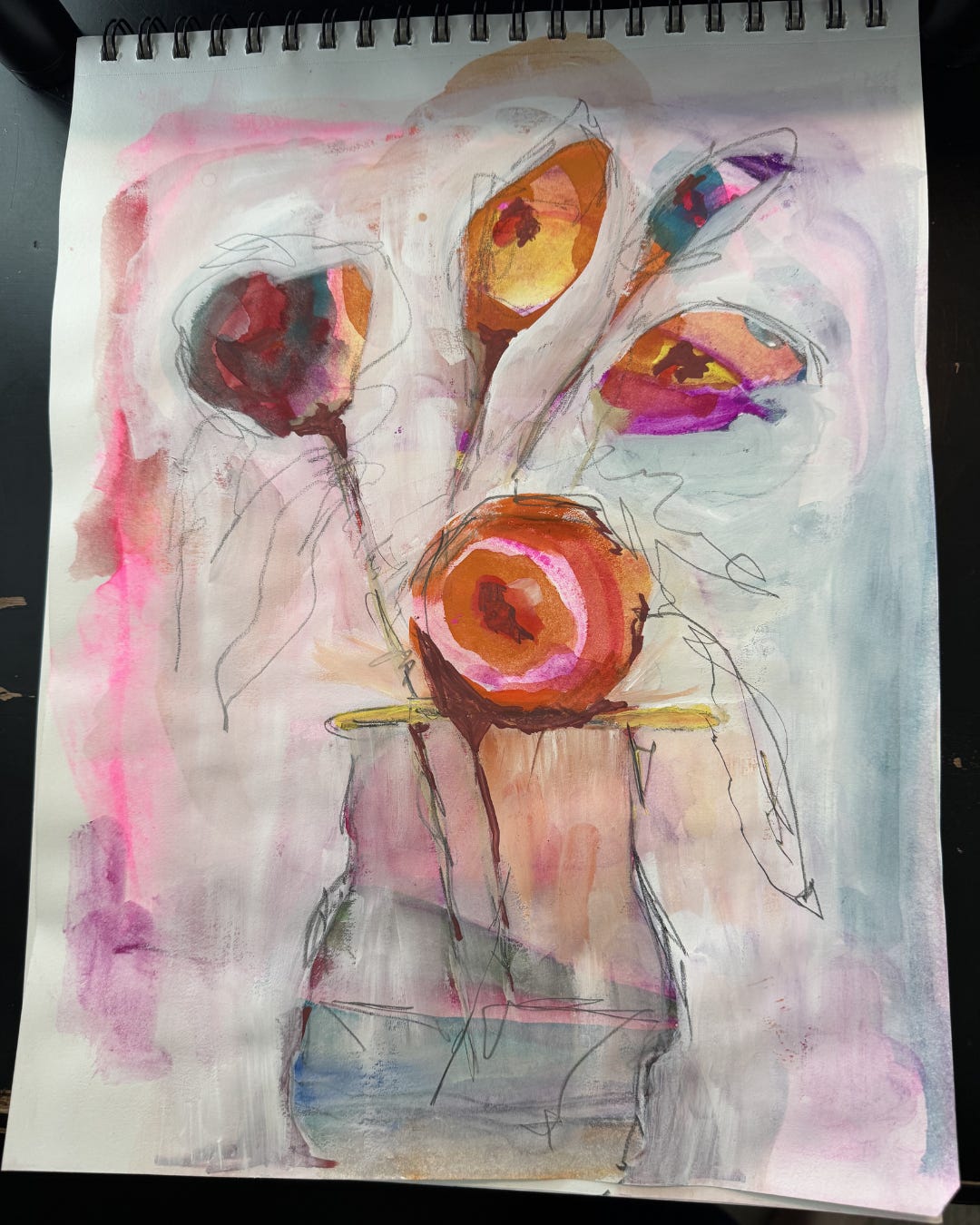
You did not stop making.
That is what makes this harder to name.
You show up.
You finish things.
The work is competent.
The proportions are right, the color is handled, the technique is there.
Anyone looking would say it is good.
And you stand in front of it and feel almost nothing, because you know something they do not. It is flat.
It is correct and empty.
It looks like art and does not feel like yours.
This is a quieter grief than not making at all, and lonelier, because you cannot point to a blank page as evidence.
You have the output.
You have the proof of work.
What you do not have is the aliveness.
Somewhere the spark went out of it and the competence kept running on its own, like a machine that forgot why it was built.
You know exactly what I mean.
Let me tell you what is actually happening.
Why competent work goes dead
The flatness is not a skill problem.
You did not get worse.
If anything you got better, and that is part of the trap.
Lifeless work is almost always over-managed work.
You have made it so many times that you now know, before you begin, how it will go.
You manage it from the first mark.
You steer away from the wrong move, the ugly color, the risky line, because you can see where they lead and you do not want to ruin a perfectly good piece.
So you make the safe choice, every time, and the safe choices add up to something with no pulse.
The aliveness you are missing lives in the part you have trained yourself to skip. It is in the wrong move you do not make.
The accident you correct before it happens.
The ugliness you smooth out on instinct. You got so good at avoiding the bad that you sanded off the alive, because they come from the same place.
The willingness to not know.
The willingness to be bad.
You cannot think your way back to it, because thinking is what flattened it.
You have to make your way back.
Badly, on purpose.
That is allowed.
For you it is the whole medicine.
The practice: five minutes, allowed to be bad
So here is what to do, and it is going to feel pointless at first, because you already make things.
Do it anyway.
The point is not to make more. It is to make differently.
Set a timer for five minutes.
Make one small thing that is allowed to be bad.
Not a piece.
Not a study.
A mark you would normally never let yourself make.
A color combination you know is wrong.
One line that goes nowhere, that you do not correct.
The point is not the result. You will not keep it.
That is almost the whole point.
The thing you make in those five minutes does not have to be good.
It only has to be loose, and unmanaged, and a little bit ruined.
If you catch yourself making it nice, you have missed the assignment.
Make it worse.
Let the bad choice stand.
You are not practicing skill.
You have plenty.
You are practicing letting go of the wheel.
Why five minutes works when discipline does not
Five minutes matters more than it sounds like it should, and for you the reason is specific.
The manager in you, the one who steers away from every wrong move, needs time to engage. I
t builds up over the course of a real piece.
By minute thirty it is fully in charge, smoothing and correcting and keeping everything safe.
Five minutes is too short for it to take the wheel.
The fear of ruining something does not have time to win, because there is nothing to ruin.
It is a scrap.
It is five minutes.
The stakes are too small to manage.
And almost every time, one of two things happens.
Either you stop at five minutes with a small ugly loose thing in front of you, and you feel something.
A flicker.
That flicker is the part of you the competent work has been missing. You just met it again.
It is still there.
Or the looseness carries into the next thing, and the next, and you make something that is messier than your usual and twice as alive, and you remember that this is why you started.
Not to be correct.
To feel that.
Both are wins.
Both are you, making something that is actually yours again.
What it gives back
You did not lose the gift.
You buried it under competence.
You got so good at making acceptable work that you forgot the alive work was always going to cost you a little control.
The flatness is not a sign you are done.
It is a sign you have been too careful for too long, and carefulness is curable.
Do this once and you feel the flicker.
Do it a few days running and the looseness starts leaking into the real work.
Do it long enough and one day you finish a piece and stand in front of it and feel the thing you have been missing, because you let it stay a little wrong, and the wrongness is where you live.
So today, set the timer.
Make the small bad thing.
Make it worse than you want to. See what you feel.
What would you make, if it only had to be alive, and not good?
The practice: Set a five-minute timer. Make one small thing that is allowed to be bad. Let the wrong move stand.
Either way, you made something alive.
Lynn
P.S. If letting the wrong move stand is easier with people beside you, that is what the Paid Subscription is for.
Each month I send a short video and a journal prompt, the kind of practice you can do in twenty minutes with whatever’s on your desk.
And once a month we meet on Zoom to make, reflect, and return together. No catching up required.
You just show up and sit down. It’s twenty dollars a month, and it’s the most honest version of what I do. Paid subscribers get all of it.
P.S.S. if you know of someone who would be helped by learning to make art and be happy then share this publication with them.
Hmmm maybe that’s what happened during the last two pieces….food for thought thanks:)
This sort of feels like an art game I used to play with my granddaughters. Each person draws a line, then the other person draws a line, until the most outrageous thing appears. They lived it! I believe this is harder to practice when you are a realism artist. And abstraction doesn’t attract you. The easiest way I can recapture my spark in my own work is to change media, or mix new media together, challenging what can result.